

How Your Emotions Take Control - Case Study
You think everything is under your control - until it isn't and greed takes over.

Hi,🙋
Welcome to the weekly CryptoFolks Newsletter. However, our launch procedures 🛫 require us to inform you not to consider this article as investment advice, as it represents solely our personal opinion. Always remember to manage your portfolios independently.💁♂️
You might think it all comes down to a lack of knowledge about investing — jumping into projects after just a few minutes of research and relying on intuition. Of course, like anyone who’s been interested in crypto or investing for more than a day, you probably believe this doesn’t apply to you… but are you 100% sure about that? 🤔
Every one of us who has ever invested any amount of money into an asset that was supposed to bring profits, only to see it turn into a loss, knows the feeling. While those “quick” or “for fun” investments are almost identical to roulette in a casino 🎰, there is one key difference that allows you to recover your invested funds (and no, I don’t mean throwing even more capital into a losing position). I’m talking about a sell order — because as you know: “If you haven’t sold, you haven’t lost.” Lol
At this moment, you may still insist that you don’t invest that way, that only inexperienced retail does this — the ones buying into a dog token just because their neighbor made 100x on it. And I don’t doubt that. But let the first person cast a stone who has never held onto a losing position, waiting for it to return to breakeven… or, during a bull market peak, at least thought about moving secured capital into a riskier asset chasing bigger profits, since “everything is going up.” I’ll start.
Like any other investor, I’m only human, and I know very little about the immediate future — and even less about potential events that could shape markets and listed companies. So sometimes, I rely on intuition. While in everyday life that might make sense, in the world of financial markets ruled by mathematics, probability, and cold statistics 📉 — it doesn’t.
There’s also another crucial aspect of investing: emotions. Emotions, combined with the belief that “I’m not like the others, I know what I’m doing,” naturally lead to negative results. By focusing on total nonsense — our ego, our infallibility, our desire for quick profits — we forget the fundamentals that are key before buying any asset: fundamental analysis, sentiment, and all that stuff. Here’s how it played out for me.
Since not much is happening in the crypto market right now, and just like you, I’m waiting for altseason, with my Bitcoin profits already secured, I decided to “make some extra” on the traditional stock market.
Feeling overly confident, thinking losses were impossible (after all, I had already made 400% on BTC), I pulled up a list of stocks looking for that one “gem.” As the “experienced investor” I was, I skipped fundamental analysis, skipped going through the company’s structure or leadership, skipped the whole due diligence process.
The only thing I looked at was the stock price and how deep it was from its ATH — pure genius. After a few minutes of hunting, I found what I was looking for — let’s call it Company X. All I knew was: its stock price was down -90% from ATH, in a 4-year downtrend, and its market cap was similar to the average coin on pump.fun 💀.
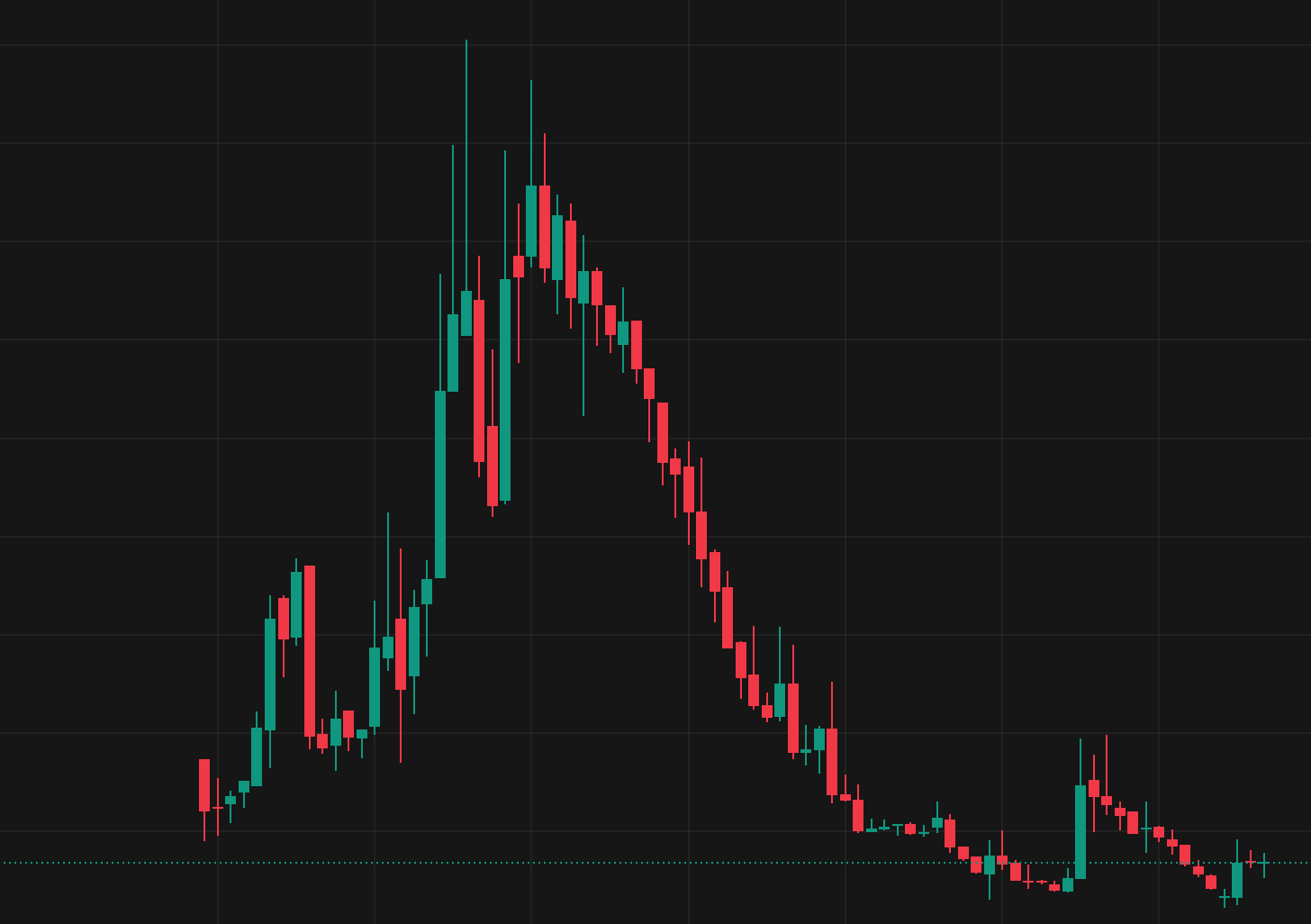
So I thought: YOLO. The price will go slightly up, I’ll make a few dozen percent, and then I’ll move on to find the next “gem.” Great mindset. What could possibly go wrong? 🙃
At first, nothing dramatic happened. The price dropped slightly by 10%, which of course I ignored — being in crypto for a few years, such things don’t impress anyone. A few days later, I became even more convinced I was the God of investing, as Company X went up and I was 20% in profit. Instead of taking gains and running while I could, what did I do? Of course! I waited for another 20%. And that’s when it started.
Over the next week, the price went back to -10%, and I grew impatient about my “quick” profit. Another 7 days passed, the stock dropped another 30%, and then hovered at that level for a long time. That’s when I thought maybe it wasn’t the best idea to blindly invest in this company. Sitting at -40%, I finally decided to do proper analysis… and realized how massive of a mistake this was.
Imagine a company with a profit margin of -168%, a return on invested capital of -155%, almost zero liquidity, no cash on hand, $14 million in debt, and a dividend yield of -18.5%. That’s what a “quick” profit looks like. 😬
After seeing that, I reached the classic conclusion you see in memes: “I don’t want profits anymore, I just want to get back to my average entry price.” So I started hoping Company X would somehow recover, but I knew it was basically impossible. Meanwhile, the stock dropped further, hitting a local bottom, leaving me at -75%. Things looked hopeless… until I read that management had filed for bankruptcy. Normally, that would be the nail in the coffin ⚰️, but in the back of my head, I thought maybe a bigger player in the industry might acquire the company.
That didn’t happen. But luckily for me, X managed a few attempts at signing partnership deals with other companies, which revived some sentiment — and the stock price suddenly jumped 160% off the bottom. Still, I was at -33%. And instead of celebrating that someone was buying, I was frustrated that I hadn’t bought the bottom myself to make those 160% — ah, emotions.
A few days later, nothing much was happening on the chart… until another news release hit: the company withdrew its bankruptcy filing. Sentiment flipped 180°, the price jumped another 48%, and I literally had just a few hours to exit with a small profit from this “quick” investment.
In the end, I realized 2.8% profit after being down -75%. But it didn’t really matter — the capital I had put into Company X was only $100, a tiny fraction of my portfolio. I wasn’t that crazy (or corrupted by crypto markets) to go all-in and risk everything for small gains. Although honestly, if I had invested more and seen a -75% loss, I probably would have cut my position early to save what was left, just like the majority of investors do.
What a ride, wasn’t it?
Even though this whole anecdote revolved around a small amount of money, it remains a valuable lesson for me: always — and I mean always — only enter projects you know and only after thorough analysis, so you don’t end up dragging skeletons out of the closet ☠️. More importantly, like I wrote at the beginning: in investing, you can’t rely on intuition or gut feeling — especially after a streak of successful trades made that way. Sure, those do happen, but it’s basically the same as betting on a roulette number and hoping to win.
The approach should always be calm, with cold calculations of all possible scenarios, especially the worst ones — because history shows that the “worst case” can always turn out even worse.
Keeping the core emotion at bay during the end of a bull market — greed 🤑 — is absolutely key to executing your plan and making money, so you don’t end up like the others stuck with altcoins down -70%, -80%, even -90% in a bear market, hoping they’ll “bounce back.” We all know most alts never return to ATH in the next cycle.
To wrap up my story, I wish you to make as much profit as possible in this bull market’s final phase — but without falling into FOMO and greed, chasing “just a little more.” Be careful when everyone is already in profit — there’s a reason they say the top is the most dangerous time in the market! ⚠️
Let’s talk about this!
